Not developed or endorsed by NARA or DVIDS. Part of the World's largest public domain source PICRYL.com.
  • Support us
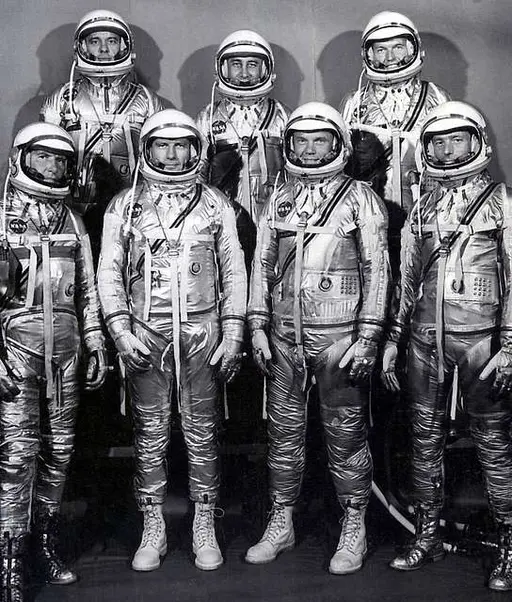
Original 7 Astronauts Inspect Mercury Model, mercury program, astronauts, spacecraft, model, nasa, space exploration, aviation history

Original 7 Astronauts Inspect Mercury Model

1959 · Defense Visual Information Distribution Service

Get the image

Need to prove or clear it?

Documentation for your legal or production needs

description

Summary

The original seven Mercury astronauts were from left, front row: Virgil "Gus" Grissom. Scott Carpenter, Donald "Deke" Slayton and Gordon Cooper; back row: Alan Shepard, Walter Schirra and John Glenn. The Mercury 7 astronauts were introduced to the American public in April 1959. The seven criteria for selection were as follows: 1. less than 40 years old; 2. less than 5 foot 11 inches tall: 3. excellent physical condition; 4. bachelor's degree in engineering or equivalent; 5. test-pilot school graduate; 6. minimum of 1,500 hours flying time; 7. qualified jet pilot. However, the process of choosing the first astronauts was elaborate and rigorous. The Langley Space Task Group believed that one of the most important prerequisites was being a test pilot. Langley engineer Charles Donlan and test pilot Robert Champine played important roles in the screening and selection process. Once selected, the astronauts began their training program at Langley. This included a "little of everything" ranging from a graduate-level course in introductory space science to simulator training and scuba-diving. Training continued until the Langley Space Task Group was transferred to Houston, Texas.
NASA Identifier: L90-4371

date_range

Date

1959
place

Location

create

Source

Defense Visual Information Distribution Service
copyright

Copyright info

Public Domain Dedication. Public Use Notice of Limitations: https://www.dvidshub.net/about/copyright

The objects in this collection are from The U.S. National Archives and Defense Visual Information Distribution Service. The U.S. National Archives and Records Administration (NARA) was established in 1934 by President Franklin Roosevelt. NARA keeps those Federal records that are judged to have continuing value—about 2 to 5 percent of those generated in any given year. There are approximately 10 billion pages of textual records; 12 million maps, charts, and architectural and engineering drawings; 25 million still photographs and graphics; 24 million aerial photographs; 300,000 reels of motion picture film; 400,000 video and sound recordings; and 133 terabytes of electronic data. The Defense Visual Information Distribution Service provides a connection between world media and the American military personnel serving at home and abroad. All of these materials are preserved because they are important to the workings of Government, have long-term research worth, or provide information of value to citizens.

Disclaimer: A work of the U.S. National Archives and DVIDS is "a work prepared by an officer or employee" of the federal government "as part of that person's official duties." In general, under section 105 of the Copyright Act, such works are not entitled to domestic copyright protection under U.S. law and are therefore in the public domain. This website is developed as a part of the world's largest public domain archive, PICRYL.com, and not developed or endorsed by the U.S. National Archives or DVIDS.  https://www.picryl.com

Language

Developed by GetArchive, 2015-2026